Monday, February 27, 2012

A Walking Meditation

The following is an article that I just had to share with my Blog readers.  It was written by a good friend, Amy Hanson.  After reading it you may want to check out her website http://amyhansonbodywork.us4.list-manage.com/track/click?u=854f7fa5e4f7e9eb5ecefd11f&id=a2e968f927&e=15e6588c51 and sign up to receive her Newsletter too.  ~ Bonnie

Each day I spend time in nature. For quite awhile this has been my form of meditation. Walking isn’t commonly considered a meditation, but it is if approached with mindfulness.

My first experience of being fully present in nature was when I was a child. I have very lucid memories of being in the forest and feeling a deep sense of connection. For me, it was as if colours, smells, sounds, tactile sensations and feelings were magnified. My heart would open and the pulse of peace would resonate throughout my whole body; a sense of being home.
As years went by, and the “busyness” of life stood in the way of the time I needed to spend in nature, I lost the ability to find this opening. Occasionally I would sit in a park or by the ocean and wonder where the magnificence had gone.

It is a long story of how I have renewed my relationship with Earth, but what I do today on my walks certainly contributes to the deepening and maintaining of that relationship.

First, I listen to my thoughts as I enter the forest. Quite often this is the time I am reviewing what has happened or what I think is going to happen in my life. I am usually in my past or in the future. What I notice at this time is that I am completely oblivious to my surroundings. .. you know, like when you drive home and don’t remember the drive! I consciously breathe; bringing me back to the moment I am experiencing right now. Having the oxygen clear my head, I slow my pace and look at my feet, focusing on the path, each small obstacle becoming the heart of my attention.

As my intention shifts, my world becomes clearer. There is a cacophony of greens shimmering from the different plants around me. Moss covered rocks, salal, sword ferns, evergreen trees and more reach out to baste my open glances. The smells on the trail shift as I walk through the different areas. Under the cover of evergreens, I smell the dampness of the shade, long without sunshine. As the trail descends to a small high-running creek, I inhale the dank odor of the rotting debris lying in the mud. Then an open field unfolds and dried grasses bend while being blown by fresh, cold air; its coldness stinging my cheeks. My feet sink into the boggy marsh, a faint squish with each step, soft and comfortable to feel. The birds, unseen, sing a spring song, even though it is early; their chirps a little higher pitched and gayer than a week before.

During the walk, I move in and out of presence. One moment, completely in the forest, the next in various circumstances affecting my life. I consciously and tenaciously bring myself back.

I become aware of my auric field surrounding me. A playfulness comes over me and I experiment with intention and how I can control the field. I draw the energy in, close to my body, sensing the containment I have created; the singleness of who I am in the universe. Then, I expand and like a blanket covering the entire forest, I feel as though the expansiveness of what I have created is a part of all there is.

My walk ends for the day and I feel filled with vigor. Clear minded and ready to face the challenges of life. I am grateful for what the walk has provided me.

Thursday, January 19, 2012

Waking up to Insomnia

As most of you know we are in the midst of moving back to Manitoba. It is a challenging time.  It gives my intention to be present for "what is" lots of practice - the waiting, the questions, and the "what ifs". Parts of me have been frustrated, angry and anxious and, not surprisingly, this has affected my sleep.  As I reflected on this I turned to an article on insomnia that I had written for the ARC "Presence and Possibility" magazine some time ago.  It reminded me about how I had dealt with insomnia in the past and helped me address my present situation.  I have found that simply breathing into the part of me who knows about being relaxed , and that soft, calm and warm feeling in my muscles and joints often short circuits my restlessness and allows me to drift off to peaceful sleep.  And when that doesn't happen, I just get up and sit with whatever is.

I know many of us, in our busy lives, struggle with bouts of insomnia, so I thought I'd share this story with you.

Insomnia, for me, has deep roots — a genetic predisposition compounded by my family history and years of wrestling this night-time demon.  As I worked through my ARC training, I realized that I had created a lot of drama around my insomnia and she had obliged by becoming bigger and stronger.  The more I resisted, the more powerful she became.  This insight inspired me to consider a new relationship.

Having learned to trust my own internal wisdom, I knew I had a choice about whether or not to remain hostage to my various parts. The decision to act on that choice, however, does not come easy.  It takes a determined commitment to personal growth and a desire to live a more authentic life.

So, as part of my commitment to myself I began to explore my insomnia, I decided that on nights when I was restless and knew that sleep was not coming I would get up.  I knew getting up would not be easy.  So, to make it as welcoming an option as possible I kept the lights low and made myself warm and cozy.  I allowed myself just to “be there” with what was — my wakefulness.  Sometimes I read or meditated, but mostly I simply rested.  Quite often I got sleepy and went back to bed where I drifted off to sleep. But, whether I went back to sleep or not, getting up when I couldn’t sleep proved to be much better than lying there twisting and turning.

Getting up when I couldn’t sleep not only short circuited my old patterns but simply  accepting being awake also enabled me to see things in a new way.  By looking at my insomnia with a new eye, and with a new name, “wakefulness,” things gradually shifted. I began to understand more about her. I know I am often awake because I’m excited — either about something that has happened or something that will happen.  I have come to realize that some of my favourite activities are quite stimulating, and not a good preparation for sleep.  I also learned that getting little sleep at night does not necessarily result in a “bad day”.  Surprisingly, I can often carry on quite well; not having a “good night’s sleep” isn’t the medical emergency I thought it was after all!

However, as I sat with my insomnia cum wakefulness I began to sense something deeper; a feeling of tightness throughout my body — a tightness holding on for all she was worth.  So, I followed that part for a while and asked a few questions.  How is it to feel this tightness?  How was it in the past to feel this tightness?  Were there times when I felt it more than others?

As I probed deeper I came to know my tightness for what she was — an anxiety that not only affected my sleep, but also undermined much of my day-to-day life.  So, once again following my commitment, I explored this anxious part.  How was it for this part to feel this way?   Where did anxiety learn to feel this way?  How would it be if this part were less tight?  As I gently listened to anxiety, it began to open up.  And, as it did, I discovered within myself a strong, almost overpowering need to look after things and to make everything work out okay for others.  No wonder I felt tight and anxious!  I was trying to hold everything together — for everyone!

This part who “needed to look after things” was hyper vigilant; it anticipated other’s needs and even took on their perceived emotions.  The anxiety which was attached to it was often so high that I would follow its directives and take immediate action on behalf of others without being asked — without finding out if this was something they wanted — without even considering my own personal costs.  As I came to know this part better I gradually began to regain my authority.  I realized that I was attempting to do the impossible.  I could never look after everything.  No amount of anxiety and vigilance could keep my family and others safe.  I could not hold everything together, and, in truth, I didn’t need to. 

As that reality sunk in anxiety started to loosen its hold and I began to feel very tired.  With that feeling, however, came a voice from the past who quickly identified this tired feeling as laziness — a big “no-no” in my family. Anxiety rushed back in, urging me to do something — anything.  I almost listened.  But now I was on to “anxiety”, so instead of doing as she wished; I simply acknowledged her presence and returned to spent time with the part who felt tired — to simply “be there” with her.  My acceptance of tiredness became so strong that one morning after a good night’s sleep I didn’t want to get up!

This was a totally new experience for me.  Yet, in line with my commitment to myself, I just lay there. And, once again, understanding came.  What I had been calling tiredness and sleepiness was really something else.  This soft, calm and warm feeling in my muscles and joints was what it felt like to be relaxed.  What a realization this was.  A part of me knew what it was to be “relaxed”!  For almost all my life this part had been buried — it had been in exile — I never even knew she existed!

I was euphoric.  I just basked in my relaxation.  For several weeks I was unwilling even to consider being anything but relaxed.  But, of course, honeymoons don’t last forever.  My anxious part did not really disappear.  What has changed, however, is my awareness.  Now I am much more attuned to anxiety’s presence and can respond to it more effectively.

As for my relaxed part, we are gradually building a trusting relationship.   It is wonderful the way I can depend on “relaxed” in moments when anxiety tries to gain the upper hand.  Simply connecting with my relaxed part, who knows how to be calm even in the midst of a storm, helps me to “be there” with my anxious part.

As for anxiety, we are also continuing to deepen our relationship.  I see how this part can act as a dependable barometer — one that signals the need to pay attention and to be present for what is really going on.  Feeling that anxiety, recognizing that something needs my attention and being able to approach it from a relaxed position is still relatively new to me.  But it feels right.  I feel empowered.

From insomnia to wakefulness; through anxiety to finding relaxation…the journey of authenticity continues.

Monday, December 19, 2011

Following the Stars

Meditation for me is a practical, down-to-earth experience.  Just being there attending to the present moment – my sensations, feelings and thoughts as I go through my day-to-day activities; brushing my teeth, washing my face, peeling the potatoes, going for a walk, interacting with others, and such is a very practical grounding experience.

Of course, my meditative practice – the time I set aside to quiet my mind by focusing  intently on something specific - sounds, visual pieces, tactile sensations, tastes and smells, and, most often, simply my own breathing is the backbone.  It helps train my mind to quiet the internal chatter and to be present for whatever is.

But ever since I was a child stars have fascinated me.  I remember how, as a very young child, “Twinkle, Twinkle, Little Star”, would, as the song says, bring me to a place of wonder.  Later on I began scanning the early night sky to wish on the first star of the evening.  And then, as a teenager, I would watch for falling stars and the promise of wonderful things to come.

Of course that was a long time ago so it took me by surprise when the presence of stars in the early morning and night sky became part of my meditations.  It wasn’t intentional at all, but sometimes at the beginning and end of a day I feel a need to expand my awareness of what is and open myself to the universe. 

So, after quieting my mind and becoming grounded, I open myself to the sky above.  What I often sense first is the cool crispness of the air – the way it fills my lungs and cleanses my body.  Then, as I breathe deeper into the sky I become aware of the stars.  As I open myself to their presence, I feel a profound connection with them and something deep inside begins to vibrate ever so subtly.  It is as if I hear the stars singing!  I never expected to sense this; I know I can’t actually “hear” the stars.  After all, the nearest star is 9,470,000,000,000 km or 4.22 light years away.  And yet, I do.

The idea of singing stars, or the Music of the Spheres, was proposed by Pythagoras more than 2,500 years ago.  Mythology turned into science in the 1970s when astronomers found that stars do pulsate, and are not stabilised by their strong magnetic field as was previously thought.  We now have actual recordings and music composed with their songs.

So, strange as it seems, I let myself be carried into the heavens by the stars.  Initially, I sense a quiet vibration, this grows as I open myself to the 100 billion stars in our galaxy, and then to the stars beyond our galaxy – an estimated 500 billion galaxies each with approximately 100 billion stars.  As I do so, my reverie deepens and the songs swell into an uplifting celestial chorus.

As I come to the ever-expanding edge of the universe and peer into the void, I become aware of a creative presence.  To me this presence is the Divine, the Alpha and Omega, the “I Am” of creation.  I am filled with this presence, and I realize I am part of this wonderful creation – and this presence is part of who I am.

 When I bring my meditation to a close and return to my earthly surroundings this experience supports me.  I move through my days with an enhanced sense of unity with others – and with all that is.  Differences pale.  I am filled with peace, love and joy. 


Afterword –

 May you also be filled with Peace, Love and Joy during this holiday season and throughout the New Year.


To hear the music of the stars for yourself, check out the following:


·         The first piece of music composed for stellar instruments: the slowly-building Stellar Music No. 1 by Jenõ Keuler and Zoltán Kolláth.


·         An old star in the constellation Hydra. It is 130 light years away and 60 times brighter than the Sun. Its sounds, which have been featured in club music in Belgium, are reminiscent of African drumming.


·         A new class of star with a powerful magnetic field. It pulses every 11.7 minutes.


 ·         Or to hear music that is more like what I hear in my Celestial Chorus look for the CD “Canticles of Ecstasy” – the music of Hildegard von Bingen (1098-1179). At a time when few women wrote, Hildegard, was known as "Sybil of the Rhine".  She produced major works of theology and visionary writings. She used the curative powers of natural objects for healing, and wrote treatises about natural history and medicinal uses of plants, animals, trees and stones. She is the first composer whose biography is known.

Tuesday, December 6, 2011

A Big One

Last week I celebrated a big birthday – my 70th!  Coming as it did in the midst of saying goodbye to the dreams we had for our life here, it found me in a vulnerable spot.
From time to time sadness comes over me and I need to embrace it and just be there with it – tuning in to what is sad for me.  As I do this, the sadness gradually softens and is replaced by openness to the future and an appreciation of what is. 
The other day, for instance, as I climbed a hill and caught a glimpse of the ocean, the realization that quite soon I would not be able to walk here and experience this wonder on a regular basis came over me.  I noted my teary eyes and heaviness throughout my body.  So, I stood there, looking out over the ocean.  I seemed rooted to the spot as my sadness drained down into the earth.  After a few minutes of honouring my sadness in this way though, I found I had begun to move on.  The beauty of the place with its rocks, waves and wonderful natural landscape moved into the forefront of my experience and the sadness faded.
As I work through my grief in this way, I find that I am “moving on”.  It happens in many different ways – sometimes with appreciation, and sometimes even with optimism and enthusiasm towards what the future may offer.  
None the less, I was feeling quite vulnerable as I approached my “three score years and ten”.  To me it was a milestone, and I knew it was something my husband would have made a big fuss over a few years ago.  But I also knew that wouldn’t happen this year.  I was sad about that, but it was more that sadness.  The part of me who felt unworthy and unloved as a child took notice and went on high alert.  Her anxiety began to flow through my veins.  Maybe nobody would help me celebrate my birthday; maybe no one likes me; and maybe I’m just not good enough!
Fortunately, I know this needy part and I was able to support her and calm her fears to some extent.  But I still felt some anxiety as my birthday approached.  I was watching for signs that I was right.  Part of me felt the need for proof.
So when the first cards and birthday greetings began to come my way I grabbed on.  Here was proof and I didn’t want to let it go!  Sad to say that didn’t work!  Try as I might, the special moments passed and the harder I tried to hold on the less special they became.
Striving to hold on engaged my mind, and mischievously it began discounting the recognition coming my way.   There was a nagging voice: that card didn’t cost much; those flowers were likely a last minute decision, and on and on.  I wanted the hugs to last longer, and I wanted more and more good things.
I was caught in the vortex of the downward spiral.  But, fortunately, I was paying attention and I knew what was happening.  So, I calmed my neediness, and after some time was able to move on with an agreement to just be there – in the moment – throughout the rest of my big day.
Well, really it was more like a big week!  People are still remembering me.  And I feel so well loved and appreciated.  I have had many, many wonderful birthday greetings - cards, flowers, hugs, phone calls, dinners, lunches – and on and on.  So many wishes and so many good feelings that I can hardly bear it!
Just shifting my intention to being present for whatever came changed how I experienced what happened.  I held each birthday moment in my awareness for however long it lasted and savoured its special richness; the feeling, the sound, the scent, the emotion.  And as that moment passed – I let it go.  I didn’t hold on.
The richness of those experiences is still warming my heart.  Thank you dear friends and family for taking time from your busy lives to make my birthday special.  Thank you for making your love for me so abundantly clear.  How could I ever have doubted?

Friday, November 11, 2011

Paradise Found – Lost – and Rediscovered

Paradise Found – Lost – and Rediscovered

Life here on the island is paradise!  Nestled between the Strait of Georgia and the west coast rain-forest, the weather is mild, the air is fresh and sweet, and good friends abound.  Life couldn’t be better!

For 14 ½ years we have enjoyed this wonderful place and have been richly blessed.  But now, as health issues become a significant concern, we realize – reluctantly, that this dream is coming to an end.  At first part of me tried to deny that it was true.  And yet, during recent personal health challenges, I realized just how tenuous things really were.   If I was out of commission for any length of time, the structure I provide would disappear and my husband would need some kind of alternate support in a hurry.

For a while I felt anger – why was this happening?  And what did we do to deserve this?  Quickly though I moved into a “fix it” mode – bargaining and denying the reality by building an impressive support network that would, in theory, be there for my husband if I became ill or incapacitated.  These friends and family members were ready to do what they could to help.  But then, some of these friends got sick and some even passed away!

Reality started to get through to me and gradually I began to accept the truth of the matter.  Our younger daughter had been encouraging me to consider moving closer to her so that she could support me for several years.  She spends considerable time with us each year and understands the stresses and challenges we face.   I, however, was not ready to see the truth as clearly as she did from her vantage point.  This fall, however, I got an email from our other daughter who is a geriatrician and deals with situations like this all the time.  In clear black and white she laid out all the reasons why she believed that we need to move back to family and why we needed to do this sooner rather than later.

One of the things she said that really hit me was that my husband could outlive me.  I know if that happened he would need to be close to family support.  I believe it was at that moment I knew what the right action was.  I really had no choice.  My husband had to be my first priority and we had to make plans to return.

Fortunately, we have three talented children who are willing to provide the kind of support we need.  They are all strong individuals with divergent skills and ways of looking at things.  So, when our son and daughter who live in Winnipeg jointly endorsed a new condo for us, we listened and proceeded to finalize.

We have offers of help with packing, and in deciding what to take and what to leave behind.  We have a line of credit and a lawyer to handle our legal affair. We have the assurance that we will have a good medical doctor and other supports when we arrive.  And we even have confidence that our car will somehow find a way to its new home.

So many things are falling into place, and now the ball is back in our park.  How will we move forward into our new life?  For me personally, I know I will be moving back with a new inner reality – a new found ability to be present for myself and others.  This allows me to accept, and yes, even embrace whatever is – whatever is already here, and whatever we will find there.  In a way, I am beginning to see that paradise is not about where we are, but rather why we are here at this time – right here – right now.   I have been given a very strong why; I have a burning purpose.

And so, as I move forward, the challenge will be how to fulfill my purpose.  As I do that, I believe I have the option of bring paradise to our new home, and to our new community.  I have an opportunity to remain the source of the calm gentle energy that I have become out here on the West Coast.  I am getting a glimpse of paradise – not as a place or a destination, but rather as a state of being.  The ebb and flow of the ocean tides runs deep in my veins, and the strength of the old-growth forest fills my heart.  I know that this quiet, calm peace will always be part of me and paradise will not be lost; it will be discovered anew!

Postscript

For those of you who have been my clients – I want to thank you – I have learned so much from you.  I hope that I will be able to stay in touch with many of you via email, Skype, and the telephone.  If you are interested I can refer you to another ARC Clinician – let me know.

Monday, October 31, 2011

Me and My Left Hip

Me and My Left Hip

For the past 4 ½ years I have struggled with my left hip; this resulted in pain, tightness and reduced mobility.  Prior to this, ignoring some subtle and some not so subtle warning signs, I was an avid hiker – I was out on the trails communing with nature two or three times a week.  And then one day towards the end of a hike, my hip and leg just seized up.

My doctor suggested taking a three month break in order to let it heal.  I wish it had been that simple.  By the end of three months, I couldn’t even go for a short walk without finding myself back in bed unable to move for days.

At this point a helpless “little girl” part somewhere deep inside had a tantrum.  She wanted her mommy.  She wanted to have her “boo-boo” kissed – she just wanted it to go away!

In desperation, I tried every mother-substitute I could find.  I was prodded, poked and stretched.  I was a good little girl and did what I was told.  I tried heat; I tried cold.  I experimented with all kinds of liniments, pills, potions and herbal remedies.  But nothing delivered the cure I needed!

And so it went for years.  Then this spring I fractured the sacroiliac joint in my other hip.  Doctors could find no reason for this, but a “light bulb” turned on.  I finally got the message: I was looking in all the wrong places.  I wanted to be rescued, but there was no rescue in sight.  It began to dawn on me that I needed to be there for myself in a new way; I needed to find my own path to wellness.   I began to understand what taking ownership of my health really meant.

Sure I had become pretty good at asking for and accepting help. I was more attuned to my body and was learning to communicate her needs more clearly.   I was even good at speaking up when I needed something – a different chair, a cushion, not to sit at all, and even saying “no”.  But more was required.

Those of you who have been reading my blog will remember the lessons I learned on my drive to northern BC when I decided to attend in a more open fashion to my body’s responses.  So, when I noticed a pain in my back or hips I allowed myself to move toward it – to be there with it and to experience what it was really like.  Did it tingle?  Ache?  Or burn?  When I did that and simply breathed into the painful area, I discovered places where I was holding tightness, anticipating the pain, and resisting it.  As I continued to breathe into the area and allowed the tension to move, shift, or release, my pain lessened.

This was one of those “Aha” moments.   I realized that for more than four years I had been resisting the pain and likely creating a vicious cycle.  The initial pain may have been the trigger, but it seemed as if my anticipation and fear of the pain was perpetuating and even enhancing the cycle.  This gave me insight into how my resistance and tensing of the already tight muscles might just be a critical part of my puzzle.

This realization empowered me.  I was no longer waiting to be rescued.  I became more aware of my response to the pain and even my response to the simple anticipation of pain.  When I did feel pain or when I noticed myself anticipating pain I began to pay closer attention. I let myself move towards the pain – towards the fear—just being there with it, noting what I was really feeling, what I was thinking, and how bad (or not) the pain really was. Surprisingly, I found that what had made it so unbearable was the part of me who anticipated the pain – the part of me who feared how bad it might get.  I began breathing into the present moment and relaxing with the actual sensations.  The pain was not as bad as I had feared; there was no need for the tense muscles.  And gradually I began to be able to move more freely – without a flare up. 

The understanding that muscle tension might be one of the big culprits helped me to consciously soften those muscles as much I could whenever I noticed them tensing.  I also began to encourage these very tight muscles to soften in other ways – exercising in the pool and providing effective acupressure with a simple tennis ball. I also began walking and doing some gentle mindful stretching every day.

I am not totally pain free all of the time, but my left hip is no longer holding forth on centre stage! I actually enjoy moving again.  I even did a three-hour hike recently without a flare up.  It has taken me quite a while to learn what I needed to learn, but my left hip and I are happy to see a glimpse of light at the end of the proverbial tunnel.
                                                        

Afterward – I thought I was so smart to have finally figured this out when I picked up a book that had already figured it out.  It’s written for back suffers, but applies to any kind of pain that doctors don’t know what to do about (or even some they do).  It’s called, “Back Sense” by Ronald D. Siegel, Michael Urdang, Douglas R. Johnson.  It suggests that most chronic back pain may start with physical injury or strain, but is caused by tight muscles which occur in response to our fears about the pain.  Mindfulness, relaxation of the tension and resuming normal activities is recommended.
 

Thursday, October 13, 2011

The Occupation on Wall Street

I just had to share this article from ~

http://matadornetwork.com/bnt/remaining-human-a-buddhist-perspective-on-occupy-wall-st/

It shows so clearly how being mindfully present affects all your life!

Remaining human: A Buddhist perspective on Occupy Wall Street

By On October 11, 2011 · 7 Comments
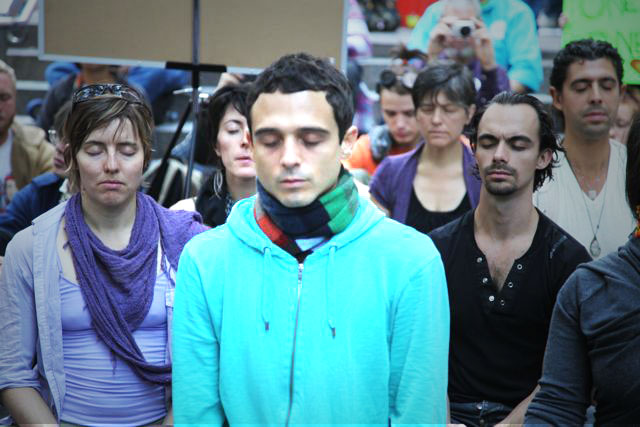
Group meditation at Occupy Wall St. / Photo: Velcrow Ripper
As the movement grows in New York and all over North America, Michael Stone believes we are creating a language to reimagine what a flourishing society looks like.
A MAN STANDS on a bench in Zuccotti Park on Wall Street and chants a phrase from a meeting last night: “We don’t want a higher standard of living, we want a better standard of living.” He’s wearing a crisp navy blue suit and typing tweets into his iPhone. Next to him, Slovenian philosopher Slavoj Žižek, wearing a red t-shirt, is surrounded by at least a hundred people as he makes his way onto a makeshift platform.
Since the protesters aren’t allowed to use megaphones or amplifiers, they have to listen carefully to the speaker’s every sentence, after which the speaker pauses, and those close enough to have heard repeat the sentence in unison for those farther away. When Naomi Klein spoke three nights ago, some sentences were repeated four or five times as they echoed through Liberty Park and down Wall Street, passed along like something to be celebrated and shared, something newborn.
Slavoj Žižek said:
They tell you we are dreamers. The true dreamers are those who think things can go on indefinitely the way they are. We are not dreamers. We are awakening from a dream which is tuning into a nightmare. We are not destroying anything. We are only witnessing how the system is destroying itself. We all know the classic scenes from cartoons. The cat reaches a precipice. But it goes on walking. Ignoring the fact that there is nothing beneath. Only when it looks down and notices it, it falls down. This is what we are doing here. We are telling the guys there on Wall Street – Hey, look down!
We are awakening from a dream. When the Buddha was asked to describe his experience of awakening he said, “What I have awoken to is deep, quiet and excellent. But,” he continues, “People love their place. It’s hard for people who love, delight and revel in the fixed views and places of absolute certainty, to see interdependence.”
Over and over, the Buddha taught that what causes suffering is holding on to inflexible views. The stories that govern our lives are also the narratives that keep us locked into set patterns, habits and addictions. The same psychological tools that the Buddha cultivated for helping us let go of one-track rigid stories can be applied not just personally, but socially. Enlightenment is not personal; it’s collective.
The media love a good fight. In Toronto during the G20, those not involved in the protests were eventually distracted by the images of a burning police car in front of the banking sectors. With burning cars and young men breaking windows, there was suddenly a more entertaining target than the real issues of coming austerity measures and avoidance of policies that deal with climate catastrophe. With violent images prevailing, the protests lost momentum because the issues were forgotten in the media.
This time, even though there is a massive police presence at most protests, the movement is not giving the media the images of broken windows that they love. Instead we are seeing a blossoming of creativity and hope.
We need a language now that allows us to reimagine what a flourishing society looks like. Any meditator knows that there are times when the thoughts that stream endlessly through awareness can eventually grow quiet. But it’s only temporary. The stories come back. But they return differently. They have more space and they are –more fluid, less rigid. We need stories to think and make sense of a world – now an ailing world that needs us. A more convenient way to apply the Buddha’s message to the social sphere is to remember that viewpoints never end or dissolve altogether, rather we learn to shift from one story to another, like a prism being turned, so that the possible ways of looking at our lives can constantly change.
“If you see others as Buddha, you are a Buddha. You remain human. You no longer try to get beyond others. “
It’s time we adapt to our economic and ecological circumstances – uncomfortable truths we’ve been avoiding for far too long. This awakening is not just about economics, it’s about ecology and our love for what we know is valuable: community, healthcare, simple food, and time.
This process of dislodging old narratives is the function of both spirituality and art. Both ethics and aesthetics ask us to let go in a way that is deep enough that we find ourselves embedded in the world in a new way. If we think of this emerging movement as a practice, we’ll see that as it deepens and we let go of habitual stories, our embeddedness in the world deepens. Intimacy deepens. Relationships deepen.
In the same way that moving into stillness is a threat to the part of us that wants to keep running along in egoistic fantasies and distraction, those with the most to lose are going to try and repress this outpouring of change. They’ll do this with police, of course, but they’ll also use subtle measures like calling us communists or anti-American, anti-progress, etc. Our job will be to keep a discerning eye and watch for this subtle rhetoric that obscures what we are fighting for.
In the Lotus Sutra it is said that the quickest way to becoming a Buddha is not through extensive retreats or chanting but through seeing others as a Buddha. If you see others as Buddha, you are a Buddha. You remain human. You no longer try to get beyond others.
A student once asked Zen master Shitou Xiquian, “What is Buddha?” Shitou replied, “You don’t have Buddha mind.” The student said, “I’m human; I run around and I have ideas.” Shitou said, “People who are active and have ideas also have Buddha-mind.” The student said, “Why don’t I have Buddha-mind?” Shitou said, “Because you are not willing to remain human.”
This student wants to transcend his life. He imagines that being a Buddha is something outside of himself, beyond his everyday actions. If you have to ask what awakening is, you don’t see it. If you can’t trust that you have the possibility to do good, to see everyone and everything as a Buddha, then how will you even begin? Our Buddha nature is our imagination.
These protests are reminding us that with a little imagination, a lot can change. We are witnessing a collective awakening to the fact that our corporations and governments are the products of human action. They aren’t serving anymore, and so it is in our power and in our interest to replace them.
We are not fighting the people on Wall Street, we are fighting this whole system.
Žižek, the protestors, the Buddha and Shitou share a common and easily forgotten truth: We cause suffering for ourselves and others when we lose our sense of connectedness. We are the 99 percent but we are dependent on the 1 percent that control forty percent of the wealth. Those statistics reflect grave imbalance in our society.
Of course people are taking to the streets. In the U.S. 44.6 percent of the unemployed have been out of work for over six months. Long-term unemployment at this level is unprecedented in the post second world war era, and it causes deep strife in communities, families and people’s health.

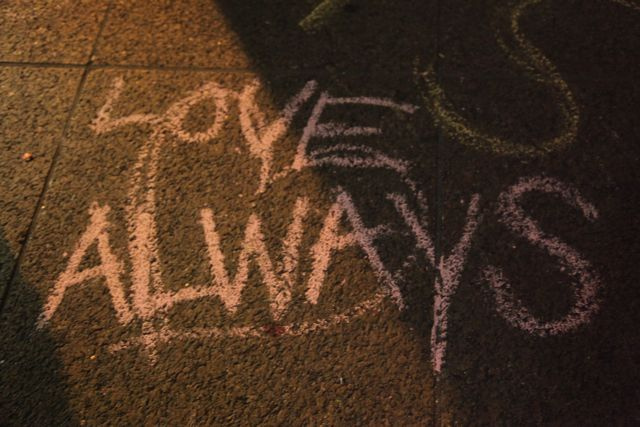
Love Always / Photo: Velcrow Ripper
This movement is also showing the power of non-violence. Non-violence, a core precept in my own Buddhist practice, is not an ideology. It’s the power of facing what’s actually going on in each and every moment and responding as skillfully as possible. The depth of our awakening, our humanness, has everything to with how we care for others. Our sphere of awareness begins to include everything and everyone. The way we respond to our circumstances shows our commitment to non-harm.
In meditation practice we can experience gaps between the exhale and the inhale, between one thought dissolving and another appearing. The space between thoughts is the gentle and creative place of non-harm. The meditator learns to trust that quiet liminal space with patience because from it, new and surprising ways of seeing our lives emerge. This is the inherent impulse of non-harm in our lives. It begins when we bear witness to the fading of one thought and the emergence of another.
These protests are exposing the gap between democracy and capitalism. The way democracy and capitalism have been bound is coming to an end. We want democracy but we can’t afford the runaway growth economy that isn’t benefiting the 99 percent. And if the 99 percent are not benefiting, the truth is, the 1 percent feel that. If there’s anything we’re all aware of these days, it’s that it’s not just twitter and email that connects us – it’s water, speculative banking, debt and air, as well. When the 1 percent live at the expense of the 99 percent, a rebalancing is certain to occur.
If we can trust in the space where, on the one hand, we are fed up with economic instability and ecological degradation and, on the other, we value interconnectedness, we are doing the same thing collectively that the meditator does on his or her cushion. We are trusting that something loving and creative will emerge from this space that we create. It’s too early to say what that may be. It won’t just be a rehashing of an ideology from the past. These are new times and requite a new imaginative response.
The people of Occupy Wall Street and now Occupy San Francisco, Toronto, Montreal, Boston, Copenhagen and 70 other cities are trying to do both: take over a space that’s being wrested from the people, and also hold the possibility of a new way of living. What’s been stolen from the people is not merely a physical space (their foreclosed homes, for example) but space to rethink how our society operates and what to do about the bottom dropping out. Even the media, looking for a hook, can’t find one. “What are your demands?” the media keep asking. The answer: “It’s too early to say.” Let’s see how much space we can hold, let’s see what our power is, and then we can begin talking about demands.
If we are going to fully express our humanity and wake up as a collective, we need to replace our youthful ideas of transcendence with the hard work of committing to the end of a way of life in which our work is not in-line with our values.
We’re demanding a fundamental change of our system. Yes, we all need to work through our individual capacity for greed, anger and confusion. This is an endless human task. We also have to stop cooperating with the system that breeds greed and confusion as it shapes our lives and our choices. This movement is the beginning of bringing that system to a halt.
From here, anything is possible